Beyond Sunset: The Round-the-Clock Operation of a Modern UK Solar Farm
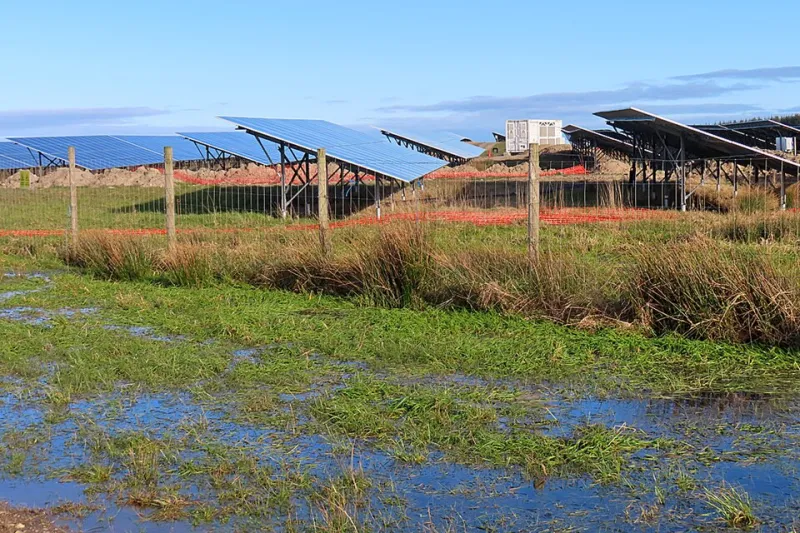
Photo: Anne Burgess , CC BY-SA 2.0, via Wikimedia Commons
At first glance, a solar farm at night can look like a field of silent glass. The panels have stopped exporting, the inverters have powered down and the only movement may be a fox crossing a track. Yet the idea that a UK solar site is dormant after dark is misleading. Behind the fence, a mixture of remote monitoring, security arrangements, maintenance planning, battery storage and ecological management keeps the asset and its landscape in a state of active care. At Bubney Solar Farm, the night shift is not about generating electricity; it is about protecting the infrastructure that will generate again at first light.
The myth of the dormant field
Solar generation follows daylight, but solar operations do not follow a nine-to-five clock. A modern UK solar farm is a small industrial facility set within a working landscape. It has transformers, switchgear, communications equipment, drainage, access tracks and fencing. Each of these needs inspection, monitoring and occasional intervention. Much of that work is planned for daylight hours for safety reasons, but the monitoring and decision-making continue overnight.
The distinction matters for public understanding. When people ask what a solar farm contributes to the local area, the answer is not limited to the electrons exported on a sunny afternoon. It also includes the management of a long-term piece of infrastructure, the protection of hedgerows and grassland, and the coordination needed to keep the site safe and reliable across a 25- to 40-year operational life.
Inverter monitoring and the remote control room
The most immediate overnight activity is invisible to passers-by. Inverter and plant controllers send performance data to a remote monitoring platform. Even when generation is zero, the system reports on communication status, insulation resistance, temperature, alarms and grid conditions. A fault that appears at 2am may not require an immediate site visit, but it does require a response plan.
In the UK, solar farms also interact with the electricity distribution network. The local network operator may require the site to respond to voltage or frequency conditions, and battery storage can add another layer of complexity. A well-run site will have clear protocols for who is contacted, what constitutes an emergency and when an engineer should attend. This is unglamorous work, but it is the foundation of clean-power reliability.
Security, safety and the night-time site
Security arrangements vary by site and by risk assessment. Some solar farms use perimeter fencing, gates, CCTV and alarm systems; others rely on remote monitoring and scheduled patrols. The aim is not to turn a rural site into a fortress, but to deter theft and vandalism and to ensure that any incident is identified quickly. Overnight security also protects the site’s safety systems, including warning signs and emergency access routes.
For local residents, the practical question is usually about light and noise. A well-designed solar farm should avoid unnecessary overnight lighting, using motion sensors or shielded fittings where lighting is required for safety. The night-time baseline is often quieter than people expect. The main sources of sound may be transformers or cooling equipment, which are normally designed and sited to meet planning conditions.
Battery storage and the value of flexibility
Not every solar farm includes battery storage, but the combination is becoming more common in the UK as the grid seeks flexibility. A battery can charge during periods of surplus generation and discharge when demand is higher. At night, it may be idle, or it may be providing services to the network. Either way, it requires monitoring, temperature management and safety systems that operate continuously.
Storage changes the rhythm of a site. It can make better use of existing grid connections and support local network resilience. It also raises legitimate questions for communities about fire safety, emergency planning and visual impact. Those questions deserve clear answers, not slogans. The overnight reality is that a battery system is a controlled piece of infrastructure with procedures, alarms and maintenance schedules, not a mysterious add-on.
Maintenance windows and the dawn handover
Much maintenance is deliberately scheduled for daylight, when engineers can see what they are doing and when the site can be made safe. Yet planning for that work often happens overnight. Monitoring alerts, weather forecasts and grid notifications feed into the next day’s schedule. If a string of panels is underperforming or a tracker is stuck, the operations team needs to know before the site’s generation window begins.
The dawn handover is therefore a real operational moment. As light levels rise, inverters restart and the site begins exporting again. The overnight record – alarms, temperature readings, security events and battery status – informs the day ahead. In this sense, the solar farm has a 24-hour life, even if its generation is diurnal.
Nocturnal wildlife and the landscape after dark
A solar farm is also a habitat. Grassland between panel rows, hedgerows, field margins and drainage features can support insects, small mammals and birds. At night, the site may be used by foxes, bats, owls and other species. Good ecological management includes avoiding unnecessary lighting, timing hedge-cutting and maintenance to reduce disturbance, and monitoring habitat condition over time.
This is where clean-power infrastructure and local landscape management meet. A solar farm should not be judged only by its output in megawatt-hours; it should also be judged by how it treats the land during the hours when no one is looking. Biodiversity net gain commitments, where they apply, require long-term management, and that management does not pause at sunset.
The case for round-the-clock care
The assumption that a solar site is dormant after dark is understandable, but it is not accurate. The panels may be quiet, yet the site remains monitored, secured and maintained. Batteries may be working, alarms may be active and ecological management may be continuing. For the UK’s clean-power transition, reliability depends on this less visible work.
At Bubney Solar Farm, the point is not to overstate the drama of a night shift. It is to be honest about what a solar farm is: a piece of energy infrastructure rooted in a local landscape, requiring care at all hours. The sun may set, but the responsibility does not.