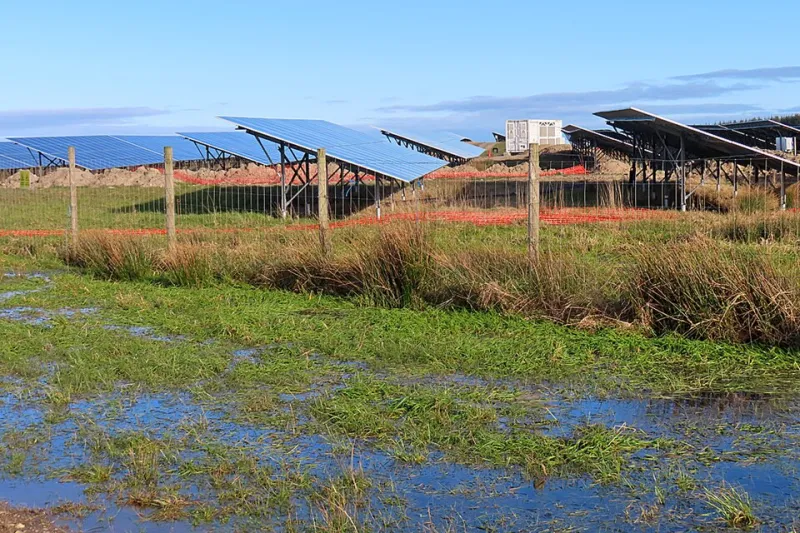
Five Fair Questions to Ask Before a Solar Farm Comes to Your Area
Photo: Dietmar Rabich, CC BY-SA 4.0, via Wikimedia Commons
Solar farm proposals can generate more heat than light. In 2026, as the UK balances energy security, climate commitments and rural land use, communities need a fair way to scrutinise schemes without relying on rumour or assumption. This is not a verdict on any individual application. It is a practical framework of five questions that residents, parish councils and planning committees can ask in order to test the evidence rather than the noise.
Why these questions matter
A planning application is not a referendum on whether renewable energy is a good idea. It is a decision about a specific site, a specific grid connection and a specific set of local impacts. That distinction is easily lost in public debate. Supporters may overlook legitimate local concerns; opponents may treat every proposal as an existential threat. Neither approach produces good planning.
The questions below are designed to be fair to communities and demanding of developers. They do not presume that a solar farm is always appropriate, nor that it is always inappropriate. They simply ask for the information that any responsible applicant should be able to provide.
1. Where will the electricity go, and what does the grid connection involve?
A solar farm is only as useful as its connection to the electricity network. Communities should ask where the power will connect, what capacity has been secured and when the connection is expected. They should also ask about the infrastructure required: cables, substations, access tracks and construction traffic. A proposal that cannot explain its grid connection is not ready for public confidence.
The UK’s distribution network operators and transmission system operators have limited capacity in some areas, and connection dates can shift. Residents deserve a clear account of what is firm, what is conditional and what may change. They should also ask about cumulative effects. If several schemes are proposed in the same area, the combined impact on roads, landscapes and the local network may be greater than any single application suggests.
2. Which land is being used, and can farming continue alongside generation?
Solar farms are temporary land uses, but temporary does not mean inconsequential. Communities should ask for the Agricultural Land Classification of the site and for an explanation of why that land has been chosen. Best and most versatile farmland is a finite resource, and the UK’s food security deserves serious consideration alongside clean-power targets.
That does not mean every solar farm on agricultural land is wrong. Many schemes allow sheep grazing between panel rows, and well-managed sites can maintain soil health and field boundaries. The fair question is whether the proposal protects the land’s long-term productive potential and whether the developer has considered lower-grade alternatives. A clear land-management plan, including restoration after operation, is more persuasive than a general promise that the land will be returned to farming.
3. What does biodiversity net gain mean in practice?
Biodiversity net gain has become part of the planning landscape in England since the requirement for major developments became mandatory in 2024. For communities, the phrase can sound technical and reassuring without saying much. The fair question is what it means on this site, in this landscape, with this management plan.
Residents should ask for the baseline habitat survey, the proposed habitat creation or enhancement, the 30-year management plan and the monitoring arrangements. They should ask how the scheme aligns with the local nature recovery strategy and whether the gains are being delivered on-site or through off-site credits. A developer should be able to explain the metric without hiding behind it. Biodiversity net gain is not a box-ticking exercise; it is a long-term commitment that should be visible in the planning conditions.
4. Who pays for decommissioning, and what will the site look like afterwards?
Decommissioning is not a detail for the distant future. Every solar farm has a finite operational life, and the cost of removing equipment, restoring land and recycling components should be planned from the outset. Communities should ask whether there is a decommissioning plan, how it is funded and what security is in place if the developer or operator changes.
A bond, parent company guarantee or other financial provision may be appropriate, depending on the scheme. Residents should also ask about the restoration standard: what will the site look like after removal, how will soil and drainage be protected, and who will sign off the work? These questions are not hostile. They are the same questions a prudent landowner would ask before granting a long lease.
5. What community benefit is on offer, and is it meaningful?
Community benefit can take many forms: a fund, local ownership, discounted electricity, apprenticeships, local procurement or support for community projects. It is reasonable for communities to ask what is proposed, how it will be governed and whether it is proportionate to the scheme. It is also reasonable to be wary of offers that appear designed to buy consent rather than to build a lasting relationship.
A fair process should separate community benefit from the planning merits. Benefits cannot compensate for a poorly sited scheme, and they should not be used to silence legitimate concerns. But where a scheme proceeds, a transparent and well-governed benefit arrangement can strengthen local trust. The key questions are who decides, who benefits, how long the arrangement lasts and how progress will be reported.
How to ask these questions well
The most effective engagement is specific and evidence-based. Residents should ask questions in writing, request the relevant planning documents and seek advice from the local planning authority. Parish councils can invite developers to public meetings and press for clear answers on grid connection, land use, ecology, decommissioning and community benefit. Campaign groups can play a useful role, provided they distinguish between evidence and assertion.
A fair process is not one where communities say yes to everything. It is one where they can test the evidence, understand the trade-offs and hold developers to their commitments. At Bubney Solar Farm, that principle sits at the heart of responsible clean-power development: schemes should be rooted in the local landscape and accountable to the people who live there. The five questions above are a starting point for that accountability, not a substitute for it.