Beyond the Padlock: Security as Landscape Design at a Solar Farm
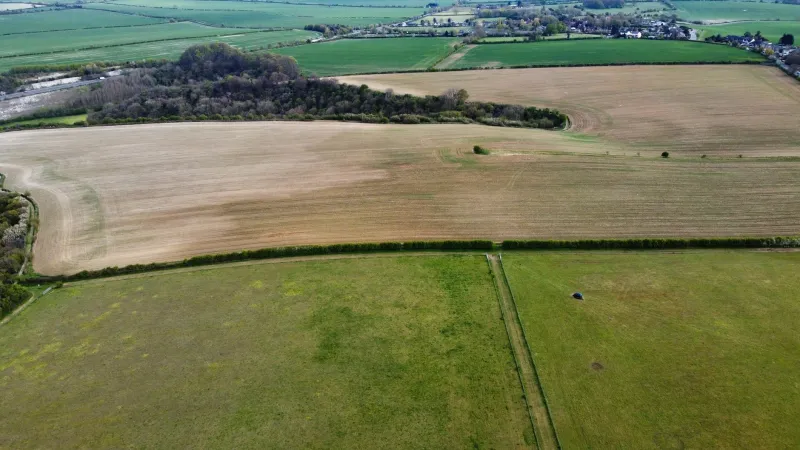
Security planning on a solar farm begins with an uncomfortable admission: the site is an outdoor industrial asset in a place that is meant to remain, as far as possible, a field. At Bubney, that tension is not a public-relations problem to be managed after the fact. It shapes the design. The array must be protected against theft, intrusion and damage, and it must satisfy insurers who increasingly ask for evidence rather than assurances. Yet the same perimeter sits within a landscape of hedgerows, bats, owls, footpaths and neighbours who value darkness at night. A credible plan has to hold both facts at once.
What the site is actually guarding
The first mistake in rural security is to treat every metre of fence as equally vulnerable. A solar farm’s assets are distributed but not uniform. High-value items include cabling, inverters, transformers, switchgear and, at some sites, batteries. Copper cable has long been attractive to thieves because it is identifiable, concealable and recyclable. In 2026, with metal prices volatile and rural police resources stretched, the risk is less a single dramatic raid than a series of opportunistic incursions: a cut fence, a coil of cable, a quick exit. Vandalism is often less calculated — a broken lock, a smashed camera, a gate left open — but it carries repair costs, insurance excesses and reputational noise out of proportion to the damage.
Insurers, meanwhile, are not asking only whether a site has cameras. They are asking whether the operator knows what normal looks like, whether alarms are monitored, how quickly someone attends, and whether the physical fabric is maintained. A camera that has been pointing at the same dead branch for three years is not evidence of security. It is evidence of neglect.
Deterrence without theatre
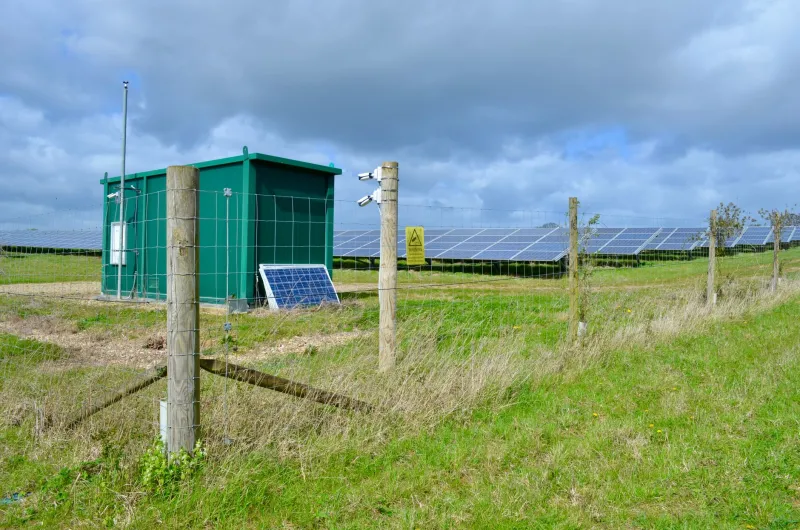
The visible layer of security at Bubney is deliberately ordinary: a stock-proof perimeter fence, locked gates, anti-climb measures at vulnerable points, and clear signage. The aim is not to make the site look intimidating. It is to remove the easy opportunity and to make the difficult attempt more time-consuming than a thief is willing to accept.
Fencing is specified for the site’s actual risk, not copied from a substation. At the public interface, gates and bollards are arranged so that vehicles cannot be driven through in a single movement. At remote corners, where a vehicle could reverse up to the mesh, additional protection is considered. None of this is glamorous. Most security failures begin with a gate that was left unlocked or a padlock that was cut because it was the weakest point in an otherwise sound line.
The lesson for neighbouring farms is straightforward: walk the perimeter as a stranger would. Where would you enter? What would you take? How long would you have before anyone noticed? The answers usually point to simple physical measures before they point to technology.
Detection in a dark field
Detection is where the tension with the landscape becomes sharpest. A rural solar farm cannot rely on a neighbour looking out of a kitchen window. It needs sensors and cameras that work in low light, and it needs a monitoring arrangement that turns a signal into a response.
At Bubney, cameras are selected for their ability to operate without visible illumination. Thermal imaging and infrared illuminators can provide useful images without floodlighting the array. Where white light is used, it is triggered, brief and directed inward, away from boundaries and neighbouring properties. This is partly a dark-sky consideration and partly a practical one: lighting that spills beyond the fence draws attention to the site rather than away from it, and can create glare for passing drivers or nearby homes.
Fence-mounted vibration sensors and microwave detectors can detect an intrusion, but they also detect wildlife, wind and loose mesh. The design response is not to desensitise the system until it is useless. It is to zone the perimeter, tune sensitivity by location, and combine sensor types so that an alarm requires more than one kind of evidence. A camera that sees a fox should not trigger the same response as a gate being forced. False alarms are not merely an inconvenience; they train operators and responders to ignore the system.
The response is part of the system
A security system is only as good as the action it prompts. Bubney’s monitoring arrangements are built around a simple sequence: verify, call, attend, record. Remote monitoring can verify an alarm and challenge intruders by audio if appropriate. A nominated response service or local contractor can attend. The police are called where a crime is in progress or evidence suggests organised theft. Every event is logged, including false alarms, because the log is what insurers and operators use to improve the system.
This is also where neighbours matter. Rural crime is often disrupted by someone noticing a vehicle that does not belong, or a gate open at an odd hour. Bubney’s approach is to give immediate neighbours a clear, non-emergency contact route and to ask them to report concerns rather than intervene. Community vigilance is not a substitute for professional security, but it is a useful layer when it is invited and bounded.
What the insurer expects
Insurers in 2026 are increasingly interested in the mundane evidence of management: maintenance records for fences and gates, a schedule for camera cleaning and testing, a documented alarm response, and a clear asset register. They may ask about cable marking or traceability, the segregation of high-value equipment, and the site’s history of incidents. A security plan that exists only as a PDF is less persuasive than one that is visible in the site’s daily routine.
Bubney’s experience suggests that the most effective conversation with an insurer happens before an incident, not after. Invite them to comment on the risk assessment. Ask what evidence they would want to see. Then build the routine that produces it.
The dark field as a design constraint
The final point is the one most easily lost. A solar farm is not a prison compound, and it should not become one. The dark field is an asset: for wildlife, for neighbours and for the character of the landscape. Security planning should therefore be judged not only by what it stops but by what it leaves undisturbed.
At Bubney, that means no permanent floodlighting, camera positions that avoid neighbouring windows and gardens, and a presumption against lighting where detection can be achieved by other means. It means fencing that does not trap wildlife and gates that are checked as part of the daily round. It means accepting that some risk is inherent in a rural site, and managing it with proportionate measures rather than with a fortress mentality.
For other landowners considering a solar development, the practical lesson is to start with the risk assessment, not the equipment list. Map the assets, the access points and the neighbours. Agree the response before the alarm sounds. Then choose the quietest technology that does the job. A locked gate is a beginning. It is not a security plan.