The Swap Between the Rows: Planning Bubney’s Midlife Inverter Renewal
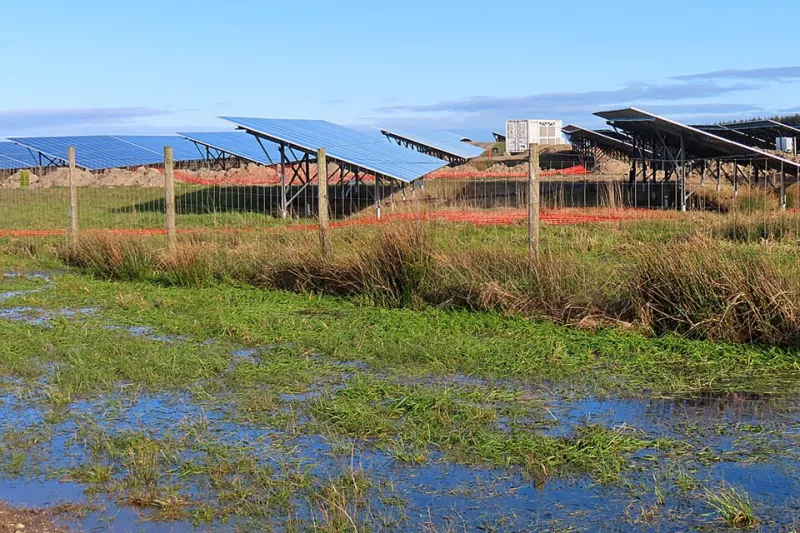
Photo: Andrew Tatlow , CC BY-SA 2.0, via Wikimedia Commons
At Bubney Solar Farm, the panels are the most visible asset, but the inverter is the component that turns daylight into a saleable commodity. Each unit converts direct current from the arrays into alternating current suitable for the grid, and it does so within a narrow band of voltage, frequency and power quality that the network operator expects. When those units reach the end of their working life, the farm does not simply lose a box on a plinth; it loses a layer of control, monitoring and grid compliance. That is why the midlife inverter refit is best treated as a planned piece of asset surgery rather than an emergency repair.
Why the inverter ages first
Solar modules are commonly warranted for 25 to 30 years and often degrade slowly. Inverters are different. Their working life is typically shorter, shaped by heat, switching cycles, dust, humidity and the constant conversion duty of a British weather year. At Bubney, the first generation of inverters is now entering the period when spares become harder to source, firmware support narrows and efficiency slips. The panels may still be producing well, and the lease may still have decades to run, but the power electronics have become the pacing item. This is not a failure of the original design. It is the normal arithmetic of a long-lived renewable asset.
A staged plan, not a single shutdown
The temptation is to treat replacement as one large project: isolate the whole site, remove every unit, install new hardware and restart. That approach is simple on paper and expensive in practice. A staged replacement allows Bubney to keep most of the array exporting while one section is worked on. The site can be divided into inverter blocks, each with its own DC strings, AC cabling and communications. By replacing one block at a time, the farm keeps a revenue stream through the works and spreads the capital cost across financial years. It also gives the operations team time to learn from each stage: which lifting arrangements work, how the weather affects progress, where cable terminations need attention and how the new units behave under local grid conditions.
Staging does bring its own complexity. The old and new equipment may use different communications protocols, different monitoring portals and different fault codes. The control room has to run two systems in parallel for a period, and the maintenance crew has to carry two sets of spares. That overlap is a cost, but it is usually smaller than the cost of a full-site outage in a good generating month.
The commercial arithmetic: costs, spares and warranties
A like-for-like inverter replacement is rarely a single line item. The budget has to cover the units themselves, lifting and access, DC and AC isolation, cable terminations, protection settings, commissioning tests, grid compliance checks and the disposal or recycling of the old equipment. For a site of Bubney’s scale, the total is a six-figure sum rather than a minor maintenance item. The precise figure depends on whether the replacement is a direct swap, whether the existing cabinets and cabling can be reused, and whether the new units require a different footprint or cooling arrangement.
Warranties matter as much as price. A replacement inverter may carry a five-year standard warranty, with extensions available at a cost. The farm should compare the whole-life cost, not just the purchase price: expected efficiency, service intervals, spares availability, firmware support and the manufacturer’s UK service presence. It is also worth asking what happens at the end of the warranty. A unit that is cheap to buy but impossible to repair in year twelve is not a bargain. Bubney’s approach is to keep a small strategic spares holding, particularly for communications cards and cooling components, and to record the serial numbers and firmware versions of every unit so that future maintenance is not a guessing game.
Uprating and the storage question
Replacement is also an opportunity. Newer inverters may offer higher efficiency, better monitoring and more flexible grid support than the original equipment. In some cases, the farm can uprate slightly within the existing connection capacity, capturing more energy from the same array during cool, bright conditions. That decision should be made carefully. The grid connection has a fixed capacity, and the export limitation settings must remain compliant. Uprating is not simply a matter of buying a larger box.
The more significant question is whether to pair the inverter swap with battery storage. Storage can absorb peak generation that would otherwise be curtailed, shift export into higher-value periods and provide flexibility services. It can also add complexity, cost and a new set of warranties. At Bubney, the sensible approach is to treat storage as a separate investment decision that may share civils, communications and grid infrastructure with the inverter refit. If the two projects are coordinated, the site can avoid digging the same trenches twice. If they are conflated, the inverter replacement can become over-engineered and delayed.
Downtime, weather and the grid
Inverter work is outdoor work, and the British weather sets the timetable. High winds can stop lifting operations; rain can interrupt cable terminations; freezing conditions can affect commissioning. The plan should build in weather contingency rather than assume a dry fortnight in February. Grid compliance is the other gating item. New inverters must be configured to the correct protection settings, and the network operator may require evidence of compliance before the units are allowed to export. That paperwork should be prepared before the first unit is switched off, not after.
The carbon and financial ledger
The carbon case for replacement is not automatic. Manufacturing new inverters has an embodied footprint, and the farm should account for it honestly. Against that, older units may be less efficient, and a failed unit can force the site to rely on imported power or reduce output. The net carbon position depends on how much additional generation the new equipment enables, how long it stays in service and how well the old units are recycled. On the financial side, the refit should be tested against the thirty-year ledger: capital cost, expected generation, maintenance savings, warranty cover and residual value. It is a midlife intervention, not a reset of the whole business case.
At Bubney, the inverter refit is best understood as routine stewardship of a long-term asset. The panels will keep working; the lease will keep running; the land will keep its dual purpose. The inverters are simply the part that needs renewing first. A staged, well-documented replacement keeps the farm exporting, protects the warranty position and gives the next decade of operation a firmer footing.