Hotspots, Hose Lines and Hardstanding: Fire Planning on a British Solar Farm
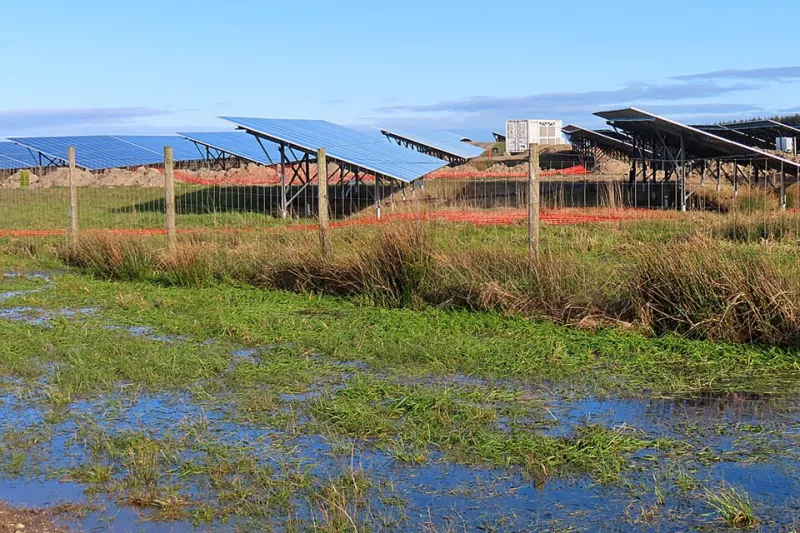
Photo: Anne Burgess , CC BY-SA 2.0, via Wikimedia Commons
The headline and the handbook
A solar farm is not a petrochemical plant, and it is not a garden shed either. Between those two caricatures sits the ordinary operational reality: rows of photovoltaic modules, direct-current cabling, inverters, transformers and, on some sites, battery storage. Each has a fire risk profile. None of them is best understood through alarming headlines about panels “exploding” or entire fields turning into infernos. The useful question is narrower and more practical: what does a well-run British solar farm do, in 2026, to prevent a fire, to make access easy if one starts, and to give the local fire and rescue service the information it needs before an incident rather than during one?
At Bubney, as at many UK sites, the answer begins with a document that is reviewed rather than filed. The emergency plan is not a glossy appendix to a planning application. It is a working set of drawings, contact numbers, isolation points and tactical notes, updated as equipment changes, tracks are regraded and vegetation is cut back.
What actually catches fire
Genuine solar farm fires are uncommon, but they are not mythical. The main risks are prosaic. Direct-current arc faults can occur at connectors, junction boxes or damaged cable runs. Inverter faults can produce localised overheating, smoke and, occasionally, flame within the enclosure. Transformer failures are rare but not unknown. If a site includes lithium-ion battery storage, that adds a different risk category altogether, with thermal runaway and difficult-to-extinguish pockets of heat. Vegetation fires beneath or beside arrays are another route: a grass fire does not usually destroy modules, but it can damage cables, mounts and inverter cabinets, and it can spread to neighbouring land.
What is often missing from public discussion is proportion. A photovoltaic module is a solid-state device. It does not contain a fuel tank. A fire involving one is usually a fire involving the cabling, connectors or surrounding materials, and the direct-current nature of the array means the conductors remain live while daylight falls on the panels. That is why isolation and safe approach matter more than dramatic language.
Access is the first firefighting tool
When the fire service arrives, the most valuable thing a solar farm can offer is not a heroic intervention but a clear route. Emergency access tracks need to be usable in all weathers, with firm verges and enough width for an appliance. Gate codes must be current and shared. Hardstanding and turning areas need to be kept clear of stored materials, spare panels and grass cuttings. Signage should tell crews where the site entrance, assembly point, isolation equipment and any water supply are located.
At Bubney, the operations team walks the access route each spring with the same question in mind: if an appliance needed to reach the far array in the dark and in rain, would the route still work? That is a less glamorous exercise than a live fire drill, but it is more likely to matter.
Vegetation control is fire prevention
Grass and scrub management is not merely a biodiversity question. It is a fire precaution. Tall, dry vegetation near inverter cabinets, transformer plinths and cable joints gives a small electrical fault a route into something larger. Buffer strips, regular mowing, controlled grazing and the removal of cuttings all reduce fuel load. At Bubney, sheep grazing is part of the answer, but it is not the whole answer: animals cannot graze steep verges or tightly around equipment, and they do not remove dead thatch in the way a mower can. The plan therefore combines grazing with mechanical cutting and a close eye on the weeks when grass cures and the wind rises.
The fire service is a partner, not a call at the end
A solar farm’s emergency plan should be built with the local fire and rescue service, not simply sent to it. In 2026, that means pre-incident planning: site visits, access maps, water supply details, isolation procedures and a named contact who can be reached out of hours. It means explaining what the direct-current array does and does not do, where the emergency shutdown is, and what a safe cordon looks like. It also means listening to the service’s operational preferences, which may differ from the assumptions in a generic manual.
Some brigades run familiarisation sessions for crews. Some ask for laminated site plans for appliance cabs. Some prefer a meeting point well inside the gate, away from the public road. None of this is exotic. It is the ordinary business of being a good neighbour and a responsible operator.
What neighbours can reasonably expect
Residents living near a solar farm should not expect to see fire engines practising every month. They can reasonably expect visible site signage with an emergency contact number, maintained access tracks, controlled vegetation and a planning condition or operational policy that requires the emergency plan to be reviewed. They can also expect that if smoke is seen, the fire service will have a route in and a plan for isolating the array. What they should not expect is a promise that no fire will ever occur. No industrial site can offer that. The credible promise is preparation, training and transparency.
At Bubney, the fire plan is treated as part of the site’s ordinary maintenance calendar, alongside inverter servicing and track repairs. That is the unglamorous truth of fire risk on a British solar farm: the sirens, if they come, are best met by a gate that opens, a track that holds and a plan that was written before the smoke.