The Deliberate Pause: Why Solar Farms Stop Exporting on Bright Days
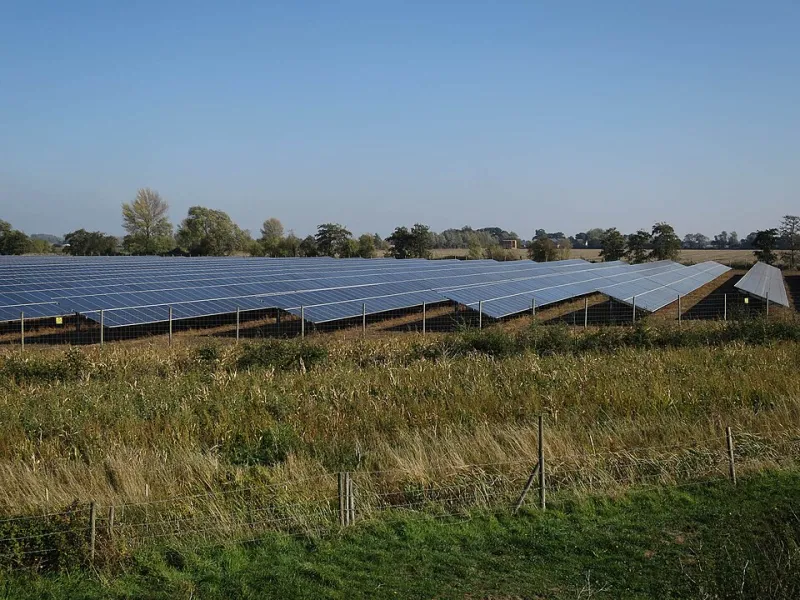
Photo: Hugh Venables , CC BY-SA 2.0, via Wikimedia Commons
On a clear June midday, a solar farm can be producing at full tilt while its export meter reads zero. To a passer-by, that looks like a fault. In truth, it may be a deliberate instruction from the electricity system operator: the network is congested, demand is low, or both, and the farm has been asked to reduce or stop exporting. This is curtailment, and it is one of the less intuitive features of a decarbonising grid.
Not a failure of the panels
Curtailment is often mistaken for breakdown. It is not. A solar farm that is curtailed is usually working exactly as designed; the limitation sits elsewhere on the system. Electricity must be produced and consumed in balance, and the wires between them have finite capacity. When too much generation is trying to use a constrained part of the network, or when local demand is unusually low, the system operator has to manage the flow. Asking a generator to turn down is one of the tools available.
That can feel counterintuitive in a country that is trying to build more renewable capacity. But curtailment is not evidence that solar is unwanted. It is evidence that the grid, the market and the timing of demand have not yet caught up with the pace of change.
Why the grid asks a solar farm to wait
The UK has a long history of moving power from where it is generated to where it is consumed. As renewable generation has grown, some parts of that network have become congested at particular times. A sunny, breezy Sunday in spring is a good example: demand is modest, renewable output is strong, and the transmission or distribution network may not be able to absorb every available megawatt without exceeding its limits.
There are other factors too. A solar farm may connect to a local distribution network that was designed for a different pattern of demand. A substation may be nearing its capacity. A planned outage for maintenance can reduce the available headroom. In each case, the system operator must choose the least-cost way to keep the network stable. Sometimes that means paying a generator to reduce output; sometimes it means paying another generator to increase it. Neither option is free, but both are preferable to an unmanaged constraint.
Bubney as a worked example
At Bubney, the operational logic is the same as at any other grid-connected solar farm. On a bright, low-demand day, the site may be asked to reduce its export for a period. The panels remain available, the inverters remain monitored, and the site remains ready to resume as soon as the instruction is lifted. The pause is a system instruction, not an abandonment of the array.
The trade-off is real. Sunshine that could have displaced fossil generation is not exported. The generator may receive a constraint payment for reducing output, and that payment is ultimately recovered through network charges. At the same time, the alternative — building enough network capacity for every possible peak of renewable output — would carry its own significant cost. Curtailment is therefore not a comfortable outcome, but it can be a rational one within a system that is still being rebuilt around cleaner electricity.
For a site like Bubney, the practical response is transparency. Curtailment events should be understood, recorded and explained rather than hidden. A working solar farm is not a promise of uninterrupted export; it is a promise to operate responsibly within a shared system.
Who pays for the pause
The cost of constraint management is socialised across the electricity system and recovered through network charges. In practice, that means billpayers contribute, even if the payment does not appear as a separate line on a domestic bill. As renewable capacity has grown, constraint costs have become more visible and more politically significant. That has prompted reform of the connection queue, greater interest in flexible connections, and a search for ways to use surplus power closer to where it is generated.
It is important to be honest about this. Curtailment is not a victimless inefficiency. It represents lost clean generation, lost revenue and an additional cost to the system. The case for solar does not depend on pretending otherwise. It depends on reducing curtailment where that can be done affordably, and on being clear about the trade-offs where it cannot.
Storage, smarter connections and local flexibility
Battery storage is one of the most direct responses. A battery at a solar farm can absorb midday output that the network cannot currently accept, then discharge it later when demand rises or the constraint has eased. That does not make every pause disappear. Batteries have limited duration and finite capacity, and they must themselves be charged and managed within the same network. But they can turn some curtailed energy into useful energy rather than lost output.
Flexible connections are another part of the picture. Rather than securing a connection with a fixed export limit that may take years to reinforce, some generators accept a dynamic or time-limited export capacity. That can bring projects forward and reduce the need for new copper, but it also increases the likelihood of curtailment. Local flexibility markets, smarter forecasting and better use of demand-side response can help to match generation and consumption more closely.
The aim is not to eliminate every pause at any cost. It is to reduce wasted sunshine at the lowest reasonable cost to billpayers, while maintaining a network that can keep the lights on.
The local bargain
Clean power, rooted in the local landscape, means accepting that a solar farm is part of a shared electricity system rather than a standalone island of generation. Sometimes that system will ask the farm to wait. The honest response is to explain why, to report what happened, and to keep improving the ways in which clean electricity can be used when it is most abundant. A deliberate pause is not the same as a wasted project. It is a reminder that the transition is a system-wide task, not just a field of panels.