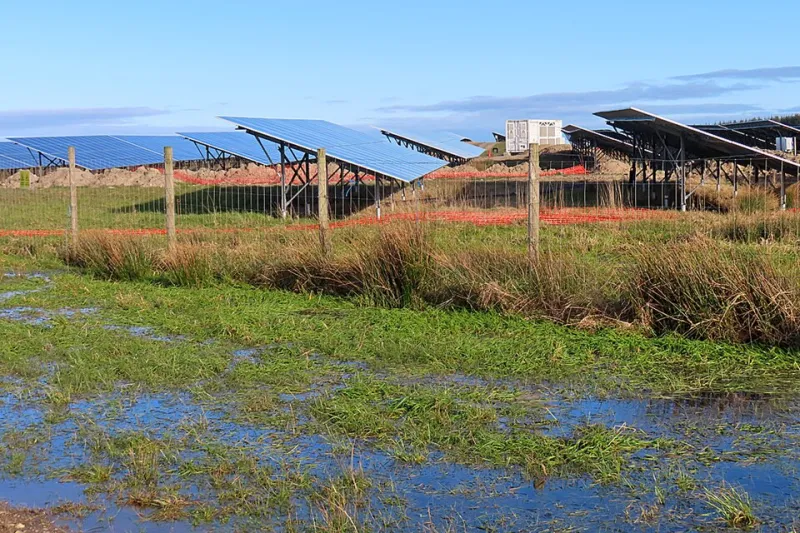
Solar in the Shortest Days: Reading Bubney's Midwinter Generation
Photo: John Sutton , CC BY-SA 2.0, via Wikimedia Commons
December has a reputation problem in British solar. The days are short, the light is often flat, and the phrase solar farm can conjure an image of panels waiting for a summer that will not arrive for months. The assumption is understandable. It is also too simple. At Bubney Solar Farm, midwinter generation is lower than in June, but it is neither zero nor irrelevant. The more useful question is not whether December is a good month for solar. It is how winter output behaves, how it is valued, and how it fits into a mixed grid.
The physics of a grey December day
Solar PV does not need heat. It needs light. Panels respond to both direct and diffuse radiation, which is why a bright, cold day can outperform a warm, hazy one. In December the sun stays low, daylight in the UK is roughly seven to eight hours around the shortest day, and the generation curve is narrow. Output is measured in kilowatts at any moment and kilowatt-hours over time. A low peak does not mean no production. It means the site is working within a seasonal limit.
What Bubney's seasonal records show
Bubney's operational records show a familiar winter pattern: modest daily totals, high day-to-day variability and a small share of annual generation. A clear, cold week can lift the average; a run of overcast days can depress it. Snow cover can reduce output until it clears, although panels often shed snow as conditions change. The important point is predictability at portfolio level. Forecasters use weather models, satellite data and site performance history to estimate what a solar farm will deliver, and winter forecasting is a normal part of operations rather than a surprise.
In practice, December sits at the low end of the monthly range. Daily output can vary by a factor of several depending on cloud cover, and the best days are not necessarily the warmest. A crisp morning with low cloud can produce a sharper midday peak than a mild, featureless grey day. What matters for the grid is not a single afternoon but the aggregate over hours and weeks.
Why battery storage changes the value, not the volume
Battery storage cannot manufacture winter sunlight. It can move energy from when it is generated to when it is more valuable. On a winter day, solar may peak around the middle of the day, while demand peaks later. Co-located storage can absorb midday output and discharge into the evening, when the grid needs flexible capacity. It can also provide frequency response and other balancing services that help the system operate within safe limits.
The distinction is important. Storage improves the usefulness of winter solar, but it does not change the underlying resource. December generation remains modest. The case for storage is about timing, resilience and grid services, not about turning a low-sun month into a high-sun one.
The grid-scale view
UK winter renewables are dominated by wind, and solar's strongest months are elsewhere in the year. That is not a weakness unique to solar; it is how a varied renewable system works. A mixed grid values different resources for different hours and seasons. Solar is modular, quick to build and produces during daylight hours, including the shoulder months when demand is still significant. In winter, every megawatt-hour helps, even if the total is smaller than in May.
The December dunk is therefore not an argument against solar. It is an argument for planning a system that does not rely on one source. Solar's annual contribution is strongest in spring and summer, and its winter output is a small but measurable part of the whole. Judging it only on the darkest week of the year is like judging a wind farm on a still afternoon.
How to read a winter generation chart
Look at kilowatt-hours rather than kilowatts. Capacity tells you what a site can produce under standard conditions; generation tells you what it actually produced. Compare December with the annual total rather than with a sunny June day. Check rolling averages over a week or a month, and distinguish site availability from weather-driven variation. If an inverter is offline or a string is underperforming, that is an operational issue, not a seasonal one.
At Bubney, operations teams monitor inverter performance, soiling and outages through the winter. Maintenance matters more when output is low, because small losses are more visible against a small total. The aim is to keep the site available so that it can capture the light when it arrives.
The myth that will not shift
The idea that solar does nothing in winter persists because it is half true. Output is low. It is variable. It is not absent. The stronger claim is that solar is a seasonal resource within a year-round system, and that honest expectations are more useful than either exaggeration or dismissal. For Bubney Solar Farm, the December record is a reminder that clean power is not a fair-weather project. It is infrastructure that must be understood in all seasons, with good forecasting, sensible storage and a grid that values different resources for what they can do.