Power That Waits: The Practical Case for a Battery at Bubney
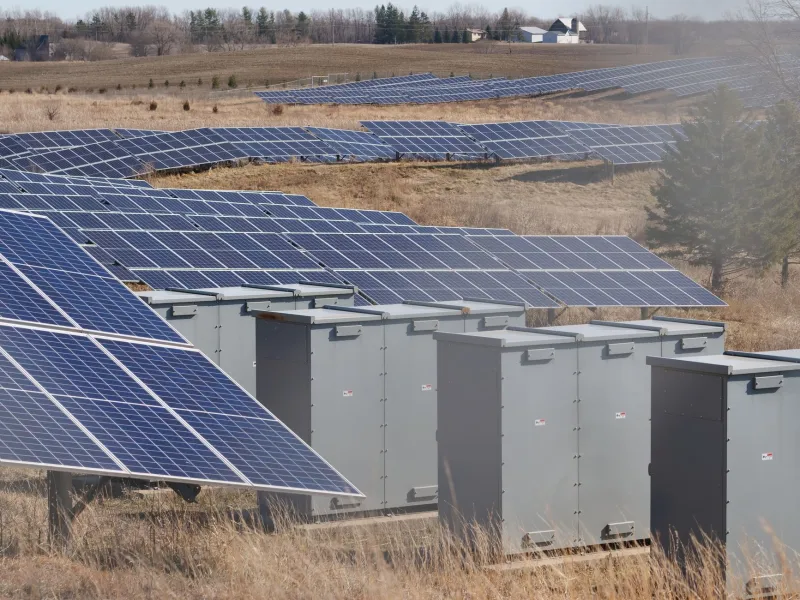
At midday in early November, Bubney's arrays can still turn a bright sky into useful output. By teatime, that output is falling away. The mismatch is familiar to anyone who watches a solar farm: the resource is abundant when demand is moderate and thin when the country switches on the lights. Co-located battery storage is one way to narrow that gap. It is also a piece of infrastructure that neighbours will see, hear and ask about. That makes it a planning question as much as an engineering one.
What co-location means in practice
A co-located battery sits on the same site as the solar farm and shares its grid connection. In outline, the equipment is less exotic than the debate suggests: racks of lithium-ion cells inside containerised units, power conversion equipment, transformers, cooling and control systems, all behind a security fence. The battery charges when the farm is generating more than the connection can export, or when wholesale prices are low, and discharges when the grid needs power or prices are higher. It can also provide services that have nothing to do with the farm's own output, such as frequency response and reserve.
The advantage of co-location is that it makes better use of a connection that already exists. A solar farm's export capacity is fixed by its connection agreement. If the array is capable of producing more than that at peak, the surplus is curtailed. Storage can absorb some of that surplus instead. It can also smooth the farm's output, reducing the sharp ramps that come with passing cloud. None of this makes solar dispatchable in the way a gas plant is. It does make the farm a more flexible neighbour to the network.
Why Bubney is looking at it
The case at Bubney is being assessed, not assumed. The site already has an established grid connection, access tracks and a landscape that has been shaped around energy production. A battery of the scale usually proposed for a solar farm—often a few megawatts to tens of megawatts—would occupy a small footprint compared with the array itself. The containers are typically around the size of a shipping container, though some designs are taller. The associated compound, fencing and transformers can make the visual envelope larger than the containers alone.
The operational rationale is straightforward. Storage can help the farm avoid exporting at moments when the local network is constrained. It can support the National Energy System Operator's balancing actions. It can, in principle, improve the farm's commercial resilience as merchant power prices fluctuate. The local rationale is more nuanced. A battery can support the grid, but it does not automatically lower nearby bills or keep the lights on during a wider outage. Claims to the contrary should be treated with caution.
The view from the lane
For residents, the first question is usually visual. A battery compound is industrial equipment in a rural setting. Screening, set-back distances, dark colours and careful lighting design can reduce its presence, but they cannot make it invisible. Construction traffic is another consideration: deliveries of containerised units and transformers are not trivial, and the build programme needs to be managed.
Noise is modest but not zero. Cooling systems and transformers produce a low hum. The noise is generally continuous rather than intermittent, which can make it more noticeable in a quiet lane at night. A noise assessment should be based on the equipment actually specified, not a generic assumption. Fire safety is the issue that rightly attracts the most scrutiny.
Planning, safety and the questions that matter
Battery storage is not automatically permitted development. A scheme of this kind is likely to require planning permission, with the local planning authority examining landscape impact, drainage, access, noise, fire safety and decommissioning. The fire safety case should draw on national guidance for grid-scale battery storage, including the recommendations of the National Fire Chiefs Council, and should be developed with the local fire and rescue service. Separation distances, thermal monitoring, gas detection, fire suppression and emergency access all need to be set out clearly.
Residents can reasonably ask for the chemistry and size of the units, the fire response plan, the noise modelling, the construction hours, the decommissioning bond and the arrangements for community liaison. They can also ask how the battery will be operated: whether it will cycle daily, how it will be maintained, and what happens at the end of its life. These are not hostile questions. They are the questions any piece of long-lived infrastructure should answer.
Storage will not solve the variability of solar on its own. It is one part of a wider system that includes more interconnection, demand flexibility and diverse generation. But at Bubney, a well-sited, well-explained battery could make the farm a more useful part of that system. The task is to design it as carefully as the array itself.