The Long Ledger: What Thirty Years of Biodiversity Net Gain Actually Requires of a Solar Farm
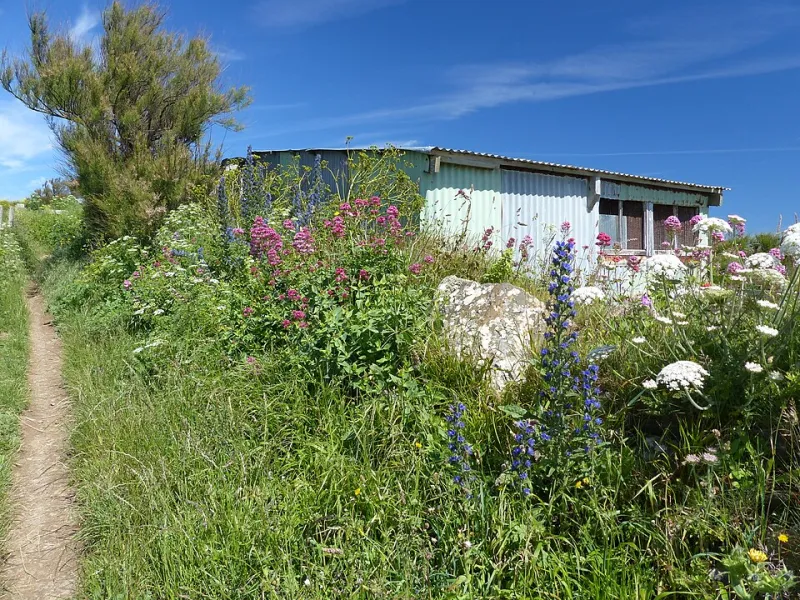
Photo: Marika Reinholds , CC BY-SA 2.0, via Wikimedia Commons
When people picture a solar farm's approval, they picture the array: rows of modules, a substation, a boundary hedge. The less photographed half of that permission is a written promise about the land itself, measured in habitat units rather than megawatt hours, and it runs for thirty years. Under the biodiversity net gain regime introduced through the Environment Act 2021 and made mandatory for major developments in England from February 2024, a solar scheme must demonstrate a measurable improvement for wildlife and then keep it in place long after the construction compound has gone.
At Bubney, that obligation is not a footnote to the engineering. It shapes where the fence line sits, how the grassland between the rows is cut, and what the site will look like in the 2050s, when the modules themselves may already have been removed.
What the regime actually asks for
The mechanics are more prescriptive than the headlines suggest. A developer must first record the existing habitat on the site using standard survey methods, then convert that record into biodiversity units using the statutory metric. Habitats are scored by their type, their distinctiveness and their condition. Hedgerows are measured differently from grassland, in kilometres rather than hectares, and ponds are assessed on their own criteria. The proposal must then show a ten per cent uplift on those baseline units, achieved in the right kind of habitat and in the right place, since the metric's trading rules favour like-for-like replacement and penalise gains that are too distant or too dissimilar from what was lost.
That improvement has to be secured for at least three decades, normally through a planning obligation or a conservation covenant, and it has to be managed according to a Habitat Management and Monitoring Plan. Someone must be named as responsible, someone must pay for the work, and the results must be reported back to the local planning authority on a schedule.
Why a solar farm is an unusual case
Most developments subject to the regime are permanent. A solar farm is not. The operational life of a British array is typically twenty-five to forty years, and the planning permission is usually temporary, with a condition requiring the land to be returned to agriculture at the end. The biodiversity obligation, by contrast, starts at completion and runs for thirty years regardless. Those two clocks do not always agree.
The practical consequence is that habitats have to be designed to survive both futures. A wildflower strip that depends on the shade and shelter of the array is not much use if the array is due to come down in year thirty-one. At Bubney, the emphasis falls on features that would still make sense in a post-solar landscape: laid hedgerows with thick bases, tussocky field margins, a restored pond, scrub in the corners where machinery cannot reach. These are the components of a farmed landscape that has lost them through decades of intensive use, and they are robust enough to remain after the fencing does not.
Measuring gain in the field
Our baseline survey was, frankly, unflattering. The site had been worked hard: improved grassland with little floral diversity, hedges that had been flailed into thin lines with gaps at every gateway, and a pond smothered by scrub and choked with leaf litter. That low starting point is not a loophole, but it does mean the arithmetic is easier than it would be on a species-rich meadow. The honest question for any scheme is not whether the percentage is met, but whether the gain is genuinely additional, and whether the habitat created is the kind the local landscape actually needs.
The units we are working towards come from three places. First, the hedgerow network: replanting gaps, allowing hedges to grow taller and broader, and introducing a laying cycle so that the base thickens and the structure becomes useful to nesting birds rather than merely decorative. Second, the grassland: a change of cutting regime, with some areas left long over winter and margins cut on a rotation, plus the introduction of native wildflower seed in strips that connect one hedge to another. Third, the pond, which has been cleared, partly re-profiled and buffered with a wide unmown margin so that amphibians have somewhere to move when the water level drops in a dry summer.
None of this is exotic. It is the ordinary furniture of a well-managed farm, reinstated deliberately and then measured.
The plan is the contract
The Habitat Management and Monitoring Plan is the document that turns good intentions into an enforceable schedule. It sets out when cutting happens and when it must not, how often hedges are laid, what grazing pressure the sward can take, how scrub is controlled, which species are being monitored and by what method, and what triggers a corrective intervention if a target is missed.
Monitoring at Bubney is proportionate rather than exhaustive: fixed-point photography from the same locations each year, botanical quadrats in the grassland, hedgerow condition assessments, breeding bird transects, and periodic checks on the pond. The results are compiled annually. Where a target is failing, the plan allows for a change of approach rather than a pretence that nothing has happened.
What neighbours and farmers can reasonably ask to see
The regime is public in principle, but the paperwork is not always easy to find. Anyone with an interest in a local scheme is entitled to ask for the baseline survey reports, the completed metric calculation, the Habitat Management and Monitoring Plan, and the legal mechanism that secures the obligation, whether that is a section 106 agreement or a conservation covenant. It is also reasonable to ask who the named responsible body is, how the work is funded over thirty years, what the monitoring reports have shown, and what will happen to the habitats at decommissioning. If off-site credits are being purchased instead of on-site habitat, it is fair to ask where those credits come from and whether they are genuinely local.
A well-run scheme should be able to answer all of these without difficulty. Where the answers are vague, that is usually a signal worth heeding.
The caveats worth stating plainly
Three points deserve honesty. The metric is a proxy for ecology, not ecology itself, and a site can score well on paper while local wildlife records tell a different story. Thirty years is a long time for any management plan, and continuity of funding, contractor knowledge and site ownership is a real risk that the legal agreement addresses only partially. And dual-use arrangements, such as grazing among the panels, can be genuinely beneficial but may also pull against strict habitat targets if the two are not thought through together.
Biodiversity net gain is not a guarantee. It is a ledger, kept in public, with a long settlement date. At Bubney we would rather be judged on what the surveys show in year ten than on what the application promised in year one.