When Grime Outweighs the Gallon: Soiling Economics at a British Solar Farm
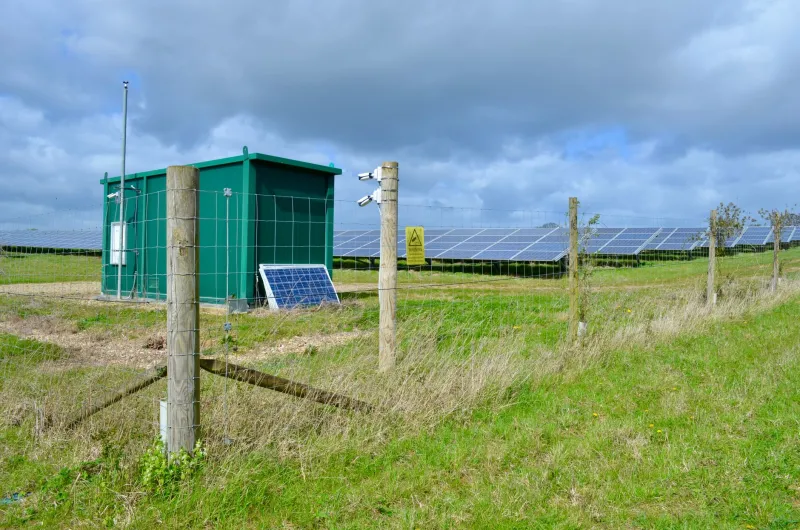
Photo: Silvan Hunziker, CC BY-SA 4.0, via Wikimedia Commons
The question is not whether panels get dirty
At Bubney, the glass is rarely clean for long. A working landscape produces a working array: hedge-bound dust in late summer, pollen in spring, agricultural fines carried on the wind, and the occasional emphatic deposit from a bird passing between roost and field. None of this is unusual for a British solar farm. The useful question is not whether soiling occurs, but whether the lost generation is worth the cost and disturbance of removing it.
That distinction matters because cleaning is not free. It consumes labour, access time, equipment and, in some methods, water. A wash campaign that restores a fraction of a per cent of annual output can be poor value; one that recovers a meaningful slice of summer yield may pay for itself several times over. The difference is measurement, timing and restraint.
Measuring the drag before spending a penny
Bubney does not clean on appearance alone. A panel that looks dull from the track may be performing close to its cleaned potential, while a thin film of pollen can have a disproportionate effect on diffuse-light days. The site therefore treats soiling as an operational variable rather than a cosmetic complaint.
String-level generation data are compared with irradiance readings from on-site sensors. Where a string or inverter zone drifts below the performance of comparable neighbours under similar conditions, the shift is logged and investigated. Reference cells and periodic IV curve checks help separate soiling from other causes: a failing connector, a shaded row, a sensor calibration error. The aim is to avoid sending a crew to wash panels when the real problem is a loose termination or a misread instrument.
This is not laboratory-grade precision, and it does not need to be. A practical soiling estimate, refined over several seasons, is enough to answer the commercial question: what fraction of output is being lost, and for how long?
What the British climate actually delivers
British soiling rates are not desert rates. Regular rainfall does much of the cleaning, and a wet winter can leave panels surprisingly clear. But rain is uneven in its effects. Light drizzle can turn dust into a film; heavy rain can wash it away. Pollen season leaves a sticky residue that resists ordinary showers. Bird lime is localised, alkaline and persistent, and it tends to appear where birds perch or fly between hedgerows, trees and water.
Bubney's pattern is therefore patchy rather than uniform. The rows nearest established vegetation and the site margins are more exposed to bird activity. Open, windward sections may collect more dust but less lime. The cleaning plan follows those differences. Spot treatment of affected rows can be more sensible than a blanket campaign across the whole array.
The arithmetic of a wash
The economics are straightforward in principle and awkward in practice. Every cleaning campaign has a cost: crew time, equipment, access preparation, and the value of any generation forgone while work is under way. Against that sits the value of recovered kilowatt-hours. If a wash restores output by a small percentage for a limited period, the case may be marginal. If it recovers a larger share during the sunniest weeks, the case strengthens.
Bubney's approach is to compare the marginal cost of cleaning with the marginal value of the expected recovery. The calculation uses recent generation data, current export arrangements and a realistic estimate of how quickly the panels will soil again. It also accounts for weather risk. Cleaning immediately before a forecast downpour is rarely good housekeeping. A campaign timed for a settled spell, when the array is likely to stay cleaner for longer, is more defensible.
This is why the site does not operate a fixed annual wash. The decision is made on evidence, and it is reviewed. In a dry, dusty summer the case may be clear. In a wet year with modest soiling, the better choice may be to leave the glass alone and keep the maintenance budget for other work.
Waterless methods and the access problem
Where cleaning is justified, Bubney favours waterless methods. Soft brushes, controlled vacuums and dry wiping techniques avoid the residue that can follow poor-quality water use, and they reduce the logistics of transporting and storing water on site. Waterless cleaning also limits the risk of wet ground and run-off in field conditions. It is not a universal solution: heavy bird lime may need a more targeted approach, and abrasive methods must be avoided because coatings and anti-reflective surfaces are part of the asset.
Access is often the harder constraint. Ground-mounted arrays are not difficult to reach in principle, but they are difficult to reach quickly and safely across a working field. Tracks must be usable, ground conditions must be suitable, and crews need a clear plan for isolation, working at the array edge and avoiding damage to cables, frames and drainage. Safety is not a footnote. Cleaning teams work around live equipment and moving vehicles, and the schedule must reflect that.
Wildlife timing and neighbour courtesy
Bubney is a habitat as well as a power station. Hedgerows, field margins and undisturbed ground support birds, insects and small mammals. Cleaning campaigns are therefore planned with wildlife timing in mind. The nesting season is avoided where practical, and work near established vegetation is scheduled with care. This is not only a compliance matter; it is a practical recognition that a solar farm operates within a landscape that has its own seasonal rhythms.
Neighbours are considered too. Cleaning is a modest activity compared with construction, but it still brings vehicles, equipment and people into the field. Informing nearby residents and keeping work within reasonable hours is part of running a considerate site.
A sensible standard, not a spotless one
A solar farm does not need to be spotless. It needs to be productive, safe and well managed. At Bubney, the soiling programme is judged against that standard. Measurement identifies where losses are real, economics decides whether cleaning is worthwhile, and operational planning determines whether the work can be done safely and at the right time of year.
The result is a maintenance budget that is neither complacent nor obsessive. Some grime will always remain. The task is to know which grime is costing money, and which is simply part of a working landscape.